RY Systems

Implementation case study

Three hours became five minutes. Fragmented records became a review-ready package.

3 hours5 minutes

One predictable processing step inside a seven-step professional workflow.

RY Systems redesigned a repetitive preparation step while preserving professional review, analysis, validation, and judgment.

Find the Right Place to StartExplore the Secure Workflow Sprint

Software handled the repetitive preparation. Professional review, analysis, and judgment remained with the tax professional.

Comparison of one predictable processing step before and after the Reason Y implementation, within a seven-step professional workflow. Before: fragmented files and unstructured data required manual sorting, repeated handling, and professional time spent on administrative preparation, producing inconsistent, difficult-to-review packages. This step took three hours. After: fragmented records became a consistent, organized, review-ready package, with predictable processing handled by software and professional time focused on analysis, judgment, and validation. This step took five minutes, a 97 percent reduction. Professional review remained part of the workflow. The redesigned step did not use AI.

R&D Tax Credit Recovery Workflow

Before and After

One predictable processing step within a seven-step professional workflow

Before

Fragmented and time-consuming

  • Fragmented files and unstructured data
  • Records scattered across systems
  • Manual sorting and repeated handling
  • Time spent chasing and consolidating files
  • Professional time spent on administrative preparation
  • Inconsistent, difficult-to-review packages
Variable, repetitive, hard to scale

One predictable processing step

3 hours

5 minutes

97% faster

After

Controlled and review-ready

  • Organized, formatted, review-ready package
  • Structured intake and formatting
  • Predictable processing handled by software
  • Controlled, traceable evidence collection
  • More consistent, traceable output
  • Professional time focused on analysis, judgment, and validation
Review-ready package. Less administrative work. More professional capacity.

The preparation bottleneck

The problem was preparation, not professional expertise.

The original process required substantial manual preparation, repeated analysis, correction, validation, and professional review.

Achieving the intended result required repeated passes, correction, validation, and rework.

The problem was not simply time. The workflow depended too heavily on manual preparation and individual effort.

The workflow’s job was preparation. The professional’s job was judgment.

The system behind the customer experience

The customer-facing experience was one part of a controlled workflow.

The complete system included customer input, workflow logic, controlled processing, professional review, and review-ready output.

Customer layer

Qualification, estimation, onboarding, and records submission.

Workflow layer

Engagement management, document processing, structured data, validation, and administrative controls.

Professional layer

Prepared records, review workflow, human judgment, and final professional work.

Reason Y customer facing homepage, cropped to the hero and estimator area
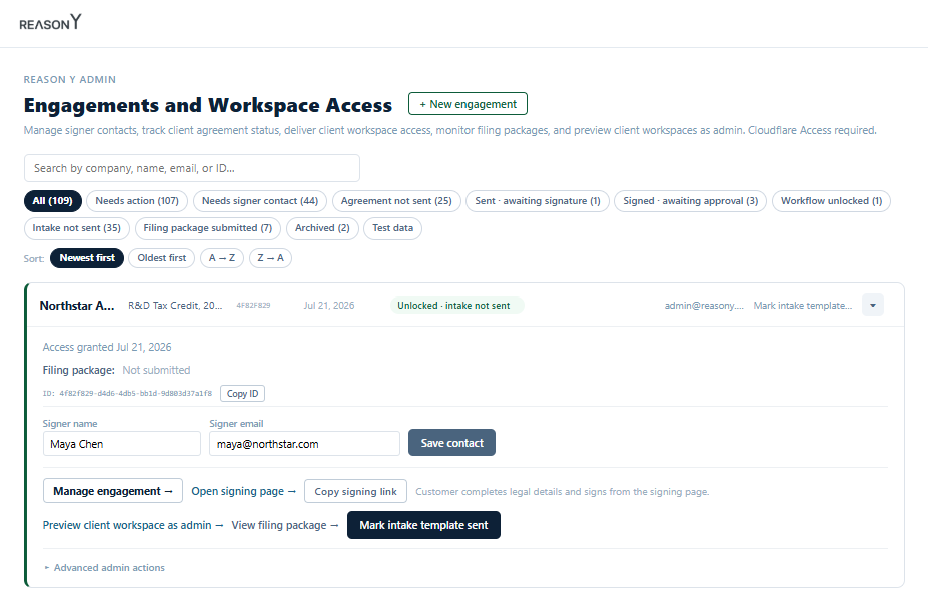
Northstar engagement administration workspace

Engagement administration

The workflow manages engagement status, access, agreements, intake, and administrative actions in one controlled workspace.

Synthetic Northstar demo engagement. No real client data shown.

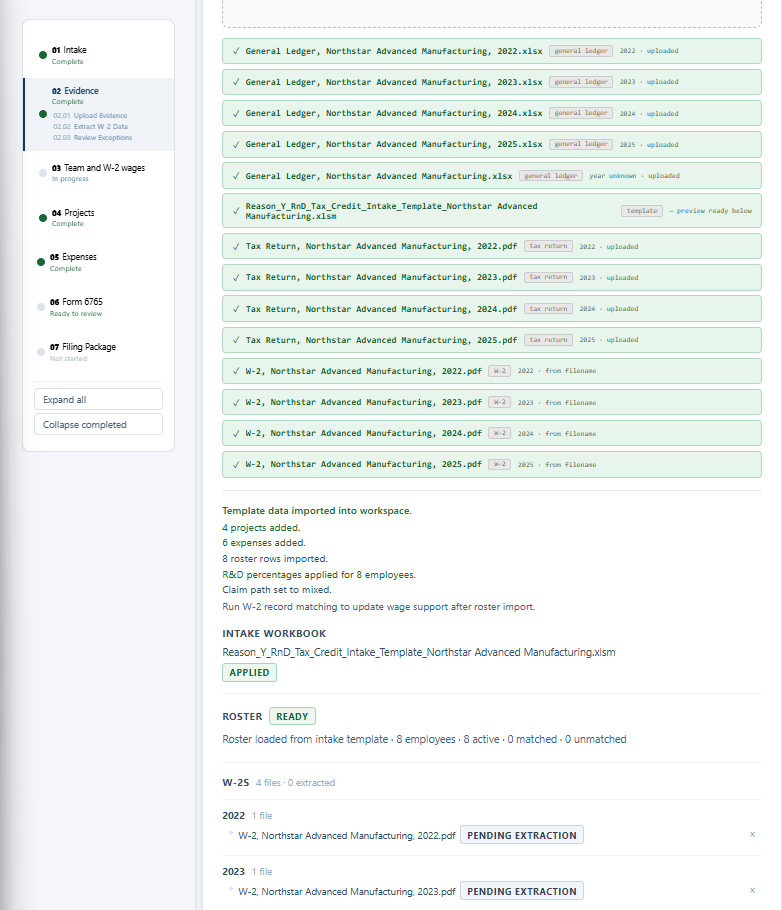
Northstar structured records and workflow preparation

Structured records and workflow preparation

Uploaded records are organized by document type and year while intake data, projects, expenses, and employee information are prepared for processing and review.

Synthetic Northstar demo engagement. No real client data shown.

What changed

Predictable preparation moved into controlled software.

RY Systems designed a controlled seven step workflow: Education → Qualification → Financial Estimation → Onboarding → Records Collection → Structured Processing → Professional Review.

Across the seven steps, the workflow collected records from the company, structured and validated the underlying data, and organized it by document type and year. Nothing about eligibility, credit calculation, or final determination was left to the software.

The program demonstrated the implementation discipline that RY Systems now applies to other business problems. The proof is not that AI was used. The proof is that the program used the right system for the work.

  • Predictable preparation moved into controlled software.
  • Fragmented records became a consistent, review-ready package, ready before professional review began.
  • Validation and traceability improved.
  • Professional judgment remained with the tax professional.

Why controlled software was the right technology

The right technology was controlled software, not AI.

No AI was used for this redesigned processing step. The work was predictable, rule-based, and required consistency rather than open-ended reasoning. Controlled software produced the better result.

The tax professional retained responsibility for analysis, validation, judgment, and client work.

Verified operational outcomes

The verified result, without the speculation.

  • Less administrative preparation.
  • More consistent, review-ready packages.
  • Better traceability and control.
  • Professional review retained.
  • More professional time for analysis, judgment, validation, and client work.

With the relevant records already organized and assembled for professional review, the tax professional needed approximately 30 minutes to prepare for the prospect conversation. This reflects one engagement; actual preparation time will vary with the size and complexity of the records involved.

The redesigned process created additional professional capacity that could be directed toward higher-value work. This reflects one engagement; results will vary with the workflow and organization involved.

Security and governance

Security and governance were part of the system, not an afterthought.

The program operated under defined controls for access, permissions, encrypted storage and transmission, and human review. The Cyber Program is based on NIST and ISO standards.

The Cyber Program documents define required controls and governance expectations. They do not, by themselves, prove that every control was implemented, tested, or independently audited during the case-study period.

Why the model still matters

The program ended. The implementation model remains relevant.

The specific tax-credit recovery window closed, but the underlying operational problem is common: fragmented information, repetitive preparation, manual handoffs, and professional review.

RY Systems applies the same implementation discipline to other workflows, AI systems, agents, and operational processes.

Reason Y provided the secure workflow infrastructure for the R&D Tax Credit Recovery Program. RY Systems designed, implemented, and operated the system built on that infrastructure. The program demonstrated the implementation discipline that RY Systems now applies to other business problems.

Learn more about RY Systems →

What is the one workflow your business should not still be doing this way?

RY Systems can help determine whether the right solution is workflow redesign, software, automation, AI, an agent, or a broader systems implementation.

Find the Right Place to StartExplore the Secure Workflow Sprint

Prefer email? Contact us at [email protected].